What a Five Thousand Dollar Landscaping Bill Taught Me About Buying in Rancho Santa Fe
Every buyer who calls me about Rancho Santa Fe asks about price. Almost none of them ask about water. That single omission is the reason the true cost of owning a home in Rancho Santa Fe surprises more buyers here than anywhere else I have worked in forty six years.
Summary. The cost of owning a home in Rancho Santa Fe is driven by acreage, not square footage. A large landscaped lot in the Covenant ran one owner five thousand dollars a month in gardening and water. The same owner cut that to roughly sixteen hundred by moving from lawn to hardscape on a comparable property.
Why Acreage Costs More Than Square Footage Here
The minimum lot size in the Rancho Santa Fe Covenant is two and a half acres, and most parcels sit larger than that. That is the entire appeal of the place. It is also the line item that catches buyers who are used to measuring a yard in square feet.
A house is a fixed thing. You can walk it, inspect it, and price its systems. Land is a running cost, and it runs whether you are looking at it or not. Water, gardening labor, fuel, equipment, and the sheer time it takes to move across two and a half acres all scale with the parcel, not with the house sitting on it.
Buyers relocating from outside the region are the ones most often caught out, because acreage reads as pure upside until the first summer bill arrives.
There is a phrase I have used with buyers here for years. You pay to play. The Covenant gives you privacy, a maintained trail system of roughly fifty miles, and a genuine sense of separation from everything around it. Those are real and I have paid for them myself since 1988. They are simply not free, and the invoice does not arrive at closing. It arrives every month afterward, and it scales with how much of the parcel you decide to keep alive.
The Numbers From Two of My Own Properties
I can give you this from my own ledger rather than from a market report, because I made the expensive version of this mistake first and then corrected it.
I built a place here with a great deal of lawn. It was beautiful and everything was new. In 2008, between the gardener and the water it took to keep that lawn alive, the property was costing five thousand dollars a month. That figure is not the mortgage, the insurance, or the property tax. That is the yard.
The last house we had, I built a house out here. The house was beautiful, but we had a lot of lawn, and between the gardener and the water to maintain it in 2008, it was five thousand a month.
Scott Union, Compass – Union West RE Group
So we sold it and bought a comparable property with an older house, and this time we did not landscape it the same way. We went mostly hardscape. By the time we sold that second property in 2021, the running cost was down to roughly sixteen hundred a month, using the same gardener I still work with today. Water alone had gone from about sixteen hundred a month to four or five hundred.
Same town. Same approximate lot size. One different decision about ground cover.
Why Leaving Land Raw Is a Strategy Rather Than a Compromise
Buyers tend to hear hardscape and think they are giving something up. In this county the opposite is closer to true, and the reason is fire.
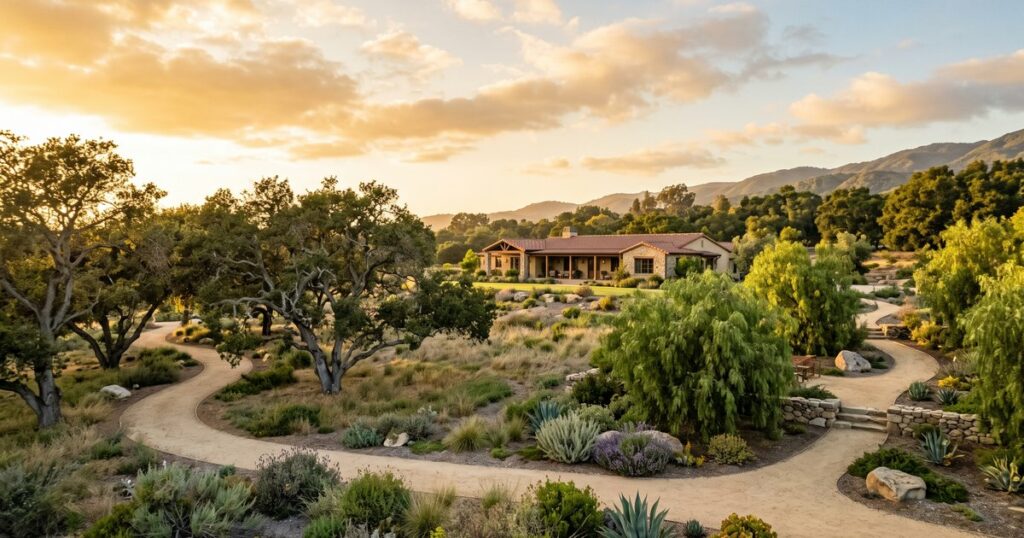
Ground you have not planted and do not irrigate is ground you are not paying to keep alive, and on a large parcel it can also serve as defensible space around the structure. CAL FIRE publishes the current defensible space standards at readyforwildfire.org, and they are worth reading before you plan any landscaping on acreage here.
On our property in Napa we have twenty acres. I weed eat every spring the native grasses along the driveways and within 200 feet of the house down to dirt, we also fenced roughly an acre around the house so the dogs, grandkids have a safe controlled area to play, we placed gravel and river rock around the perimeter of the house and used native stone for our front courtyard patio, planter boxes and the covered rear patio creating extended defensible space areas that were very eye pleasing, functional and low maintenance. Off the back patio we step down about 10 feet to another stone patio then another 4 feet to a nice grass area with a 4 foot boulder retaining wall. The slope on the back of the wall to the 8 foot deer fence +/- 20 feet is keep weed free as dirt. This creates pleasing and very effective defensible spaces. The rest of the 20 acres we leave as native ground with fire resistant Oak trees.
It is manageable, it looks the way we want it to look, and it is not fighting us every month.
The same logic applies on a Covenant parcel. You are not obligated to irrigate two and a half acres simply because you own two and a half acres.
What Insurance and Water Availability Add to the Picture
Two costs have moved faster than anything else in this market over the last several years, and neither of them shows up on a listing sheet.
Insurance in the wildland areas of San Diego County has become genuinely difficult, and it belongs in your budget conversation before you write an offer rather than during escrow. The California Department of Insurance maintains current consumer guidance on residential coverage in high fire risk areas at insurance.ca.gov.
Water is the other. Rates and tiers in this county are set at the district level and they have not moved downward. If you are evaluating a property with mature irrigated landscaping, the current owner’s actual billing history is the most useful, and it is worth asking for it directly.
If you are weighing an acreage purchase here and want the running numbers before you commit, reach out and I will walk the property with you.
How the Parcel Itself Changes the Running Cost
Two properties on the same street, both two and a half acres, can cost meaningfully different amounts to run. The variable is where the parcel sits and which way it faces, and it is almost never discussed on a showing.
If you are down in a valley low, you get temperature swings. You will wake up and find it twenty degrees cooler than when you went to bed, purely from the elevation difference. At the first house I bought in Rancho Santa Fe the driveway sat below the house, and walking down for the paper in the morning was a seven to ten degree drop. In summer, you welcome that. In winter, not so much.
Sitting low also means the prevailing breeze may never reach you. Air that does not move brings mosquitoes and everything that comes with standing conditions, and it changes how much you use cooling through the warm months.
Orientation does the same work. A house facing west away from the coast takes the low sun straight through the glass at sunset, which heats the rooms you are most likely to be sitting in. Facing south with a pool gives you sun across the day. Facing north with tall glass and privacy can mean you never need a window covering at all.
None of this is exotic. It is simply the difference between a property that works with the site and one that spends money fighting it every month for as long as you own it.
The Two Questions to Ask Before You Write an Offer
There are two numbers that matter more than almost anything you will negotiate on price, and most buyers never ask for either one.
First, what does it currently cost to maintain this property exactly as it sits. Not an estimate. The actual gardening contract and the actual water billing for the last twelve months, including a full summer.
Second, what would it cost to run if the ground cover changed. If a substantial share of the parcel came out of irrigation and went to hardscape or bare defensible ground, where does the monthly number land.
The gap between those two figures is frequently larger than anything you are going to win at the negotiating table, and unlike the purchase price, it repeats every month for as long as you own the property. For the wider picture on what the Covenant actually asks of an owner, see the full Rancho Santa Fe buyer guide.
Frequently Asked Questions
What does it actually cost to maintain a property in the Rancho Santa Fe Covenant?
It depends almost entirely on how much of the parcel is irrigated. A large landscaped lot with significant lawn ran one owner about five thousand dollars a month in gardening and water in 2008. A comparable parcel run mostly as hardscape came in around sixteen hundred a month. The house size matters far less than the ground cover.
Why is the minimum lot size in the Rancho Santa Fe Covenant so large?
The Covenant was established with large minimum parcels to preserve the low density, semi rural character of the community. Most parcels sit at two and a half acres or larger. That standard is what produces the privacy and the trail system, and it is also what drives the maintenance cost.
Is hardscape a downgrade compared to landscaping on a large lot?
Not in this county. Unirrigated ground costs little to keep alive and can double as defensible space around the structure. Many owners on acreage here run lawn only immediately around the house and leave the balance as hardscape or bare ground by choice rather than by necessity.
What should I ask a seller about ownership costs before making an offer?
Ask for the actual gardening contract and twelve months of water billing that includes a full summer, rather than an estimate. Then ask what the monthly figure would look like if a meaningful share of the parcel came out of irrigation. Those two numbers frame the real cost of the property.
How does wildfire risk affect the cost of owning acreage in San Diego County?
It affects insurance availability and pricing, and it shapes what you are required to maintain around the structure. Defensible space standards are published by CAL FIRE and apply to properties in the wildland interface. Both belong in the budget before closing rather than after.
Do property taxes work differently in Rancho Santa Fe than elsewhere in California?
The underlying rules are the same statewide under Proposition 13 at 1%, with assessment based on purchase price. Local approved sewer bonds, school bonds and other local costs are added to the 1% and billed semi-annually. Confirm any specific tax question with a qualified tax advisor.
Does the Rancho Santa Fe Covenant include amenities in the cost of ownership?
Property ownership in the Covenant includes a social membership in the golf club, access to a maintained trail system of roughly fifty miles, and the Rancho Santa Fe Patrol. The RSF Covenant HOA Fee for 2026 is $1,500 for each assess million. Thus, a 5 million dollar property with pay an RSF Association fee of approximately $7,500 or $625 per month. This compares favorably with the HOA fees of surrounding gated communities.
Is it cheaper to own in Rancho Santa Fe or closer to the coast?
They are different cost structures rather than a simple ranking. Inland acreage carries water and landscape maintenance. Coastal property carries salt air exposure, which drives repainting and repair on a much shorter cycle. Neither is inherently cheaper, and the right comparison depends on the specific parcels.
The Number That Repeats Every Month
Purchase price is negotiated once. The cost of running the land is negotiated never, and arrives every month for as long as you hold the property.
That is not an argument against buying acreage here. I have owned in this community since 1988 and I am still here. It is an argument for walking in with the real numbers rather than the ones on the listing sheet, because the difference between a property that fits comfortably and one that grinds on an owner is usually a decision about ground cover that was made long before closing.
If you are considering a property in Rancho Santa Fe and want an honest read on what it will cost to run, start a conversation with Scott Union.
About the Author
Scott Union has been selling real estate in Rancho Santa Fe, La Jolla, and Del Mar since 1980, and living in these communities since 1970. He opened his own brokerage in 1984 and today leads Compass – Union West RE Group, where every client works with him directly alongside Realtor Morgana Taylor, not with an assistant or the next agent in training.
Most of what he writes here comes from his own ledger rather than from a market report. He has owned, built, or renovated more than twenty properties across these markets, including two custom homes built from the ground up. When he moved to Rancho Santa Fe in 1988 he waited seven years before showing his first house there, because he does not sell a market he does not know cold.
In 2023 he closed $99,274,400 and was named the number 8 agent in San Diego by sales volume, featured that year on the America’s Best list.
Scott Union, Broker Associate, Compass. California DRE #00808482. Rancho Santa Fe, California. (858) 518-9663.